Under Prefectoral Order 2009/0126, the CYROI research animal facility is authorised for the breeding and use of animals for scientific purposes – rodent and lagomorph species
Areas of activity
- Fundamental research
- Efficacy or toxicity testing of drugs and other biological and chemical substances
- Food quality control
- Teaching
Facilities
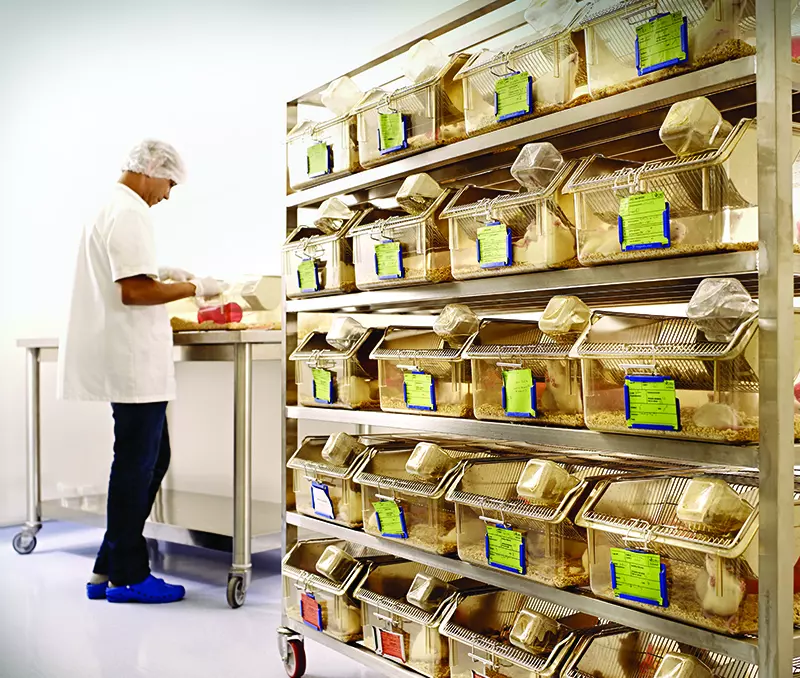
The animal facility comprises two zones: a conventional area and a more confined A1+ area, allowing the housing of immunocompromised animal models.
Each zone has its own dedicated laboratory. All facilities comply with the recommended design guidelines, including air ventilation and treatment, constant temperature and humidity, artificial lighting respecting the natural rhythms of the animals, soundproofing and background music.
Veterinary responsibility: The animal facility is under the veterinary responsibility of Dr Eva Naffrichoux.
Strictly controlled access
Level I
Protocol and research project leaders (4+ years of higher education)
Level II
Technicians performing procedures under supervision
Level III
Animal care staff responsible for husbandry and care
OUR RESEARCH PROJECTS
NanoBioScars Project
Évaluation de nouveaux pansements bioactifs pour la cicatrisation cutanée et osseuse — INTERREG VI Océan Indien
Innovative bio-dressings for Indian Ocean populations
The NANOBIOSCARS project aims to evaluate new bioactive dressings for skin and bone tissue healing. The main objectives are:
- Evaluate the healing potential of bio-dressings on healing models
- Study the effect of cannabinoids on skin healing
- Develop prototype enhanced dressings for Indian Ocean populations
This project is funded by the European Union under the Interreg VI Indian Ocean programme, whose managing authority is the Reunion Regional Council.


Nano Scaffold Project
Synthèse de nouveaux biomatériaux issus de la biodiversité OI pour la régénération tissulaire — FEDER-FSE+
Valorising Indian Ocean biodiversity for regenerative medicine
Synthesis, characterisation and evaluation of new biomaterials (nanoscaffolds) obtained from polymers derived from Indian Ocean biodiversity, for tissue regeneration.
This project is co-funded by the European Union under the FEDER-ESF+ Réunion programme, whose managing authority is the Reunion Regional Council. Europe is committed to Reunion Island through the FEDER.