NUCLEAR MAGNETIC RESONANCE
NMR uses the same fundamental principle as MRI (Magnetic Resonance Imaging). It relies on the magnetic properties of atomic nuclei such as hydrogen (¹H), carbon (¹³C), nitrogen (¹⁵N) or fluorine (¹⁹F) in the presence of a strong magnetic field.
In the case of MRI, this makes it possible to obtain 2D or 3D images of body parts such as the brain or heart, and to diagnose conditions like multiple sclerosis, identify tumours or study joint problems.
FIELDS OF APPLICATION
NMR enables the study of molecules. Its fields of application have continuously grown over the past 25 years. Two types of NMR are distinguished: liquid-state NMR and solid-state NMR.
Molecular biology
In high-field liquid-state NMR, one of the flagship applications is the study of the structure of biological macromolecules (proteins, DNA), their interactions and their movements, which helps better understand their function.
This type of research earned the 2002 Nobel Prize in Chemistry for Kurt Wüthrich, a pioneer in the field who, for example, by determining the structure of the Prion, helped better understand the mechanisms responsible for Bovine Spongiform Encephalopathy (BSE), more commonly known as "mad cow disease".
Chemistry and Pharmacology
NMR is widely used in chemistry to identify and/or characterise molecules obtained through synthesis or extracted from plants.
In pharmacology, NMR is also used to identify potential drug candidates.
Medicine and Diagnostics
In the medical field, the technique is increasingly used to analyse the molecular composition of biological fluids such as blood serum and urine, enabling the diagnosis of certain diseases.
Very recent developments now make it possible to study the composition of intact tissues such as biopsy fragments, without requiring a molecular extraction step that alters sample composition. This technique shows great promise for the early diagnosis of tumours, particularly in breast cancer.
Food and agriculture
The same technique is also applied in food science by analysing the composition of foods such as fruits, cheese, meat and fish, placed directly in the instrument.
This list is not exhaustive, and the range of NMR applications will undoubtedly continue to grow in the coming years, as it offers a major advantage over other techniques: it does not destroy the sample.
USERS

Sébastien BENARD
NMR Manager
Responsibility for the NMR has been entrusted to Mr Sébastien BENARD. He coordinates the scheduling of NMR experiments and ensures the proper operation of the instrument, with the support of NMR specialists from the various teams based on the platform.
OUR EQUIPMENT
Performance
Our NMR spectrometer is equipped with a superconducting magnet enabling high-resolution analyses and exceptional sensitivity for the study of molecules.
Types of analyses
Our equipment enables the analysis of ¹H, ¹³C, ¹⁵N and ¹⁹F nuclei, as well as two-dimensional experiments for the complete structural elucidation of the compounds studied.
Features
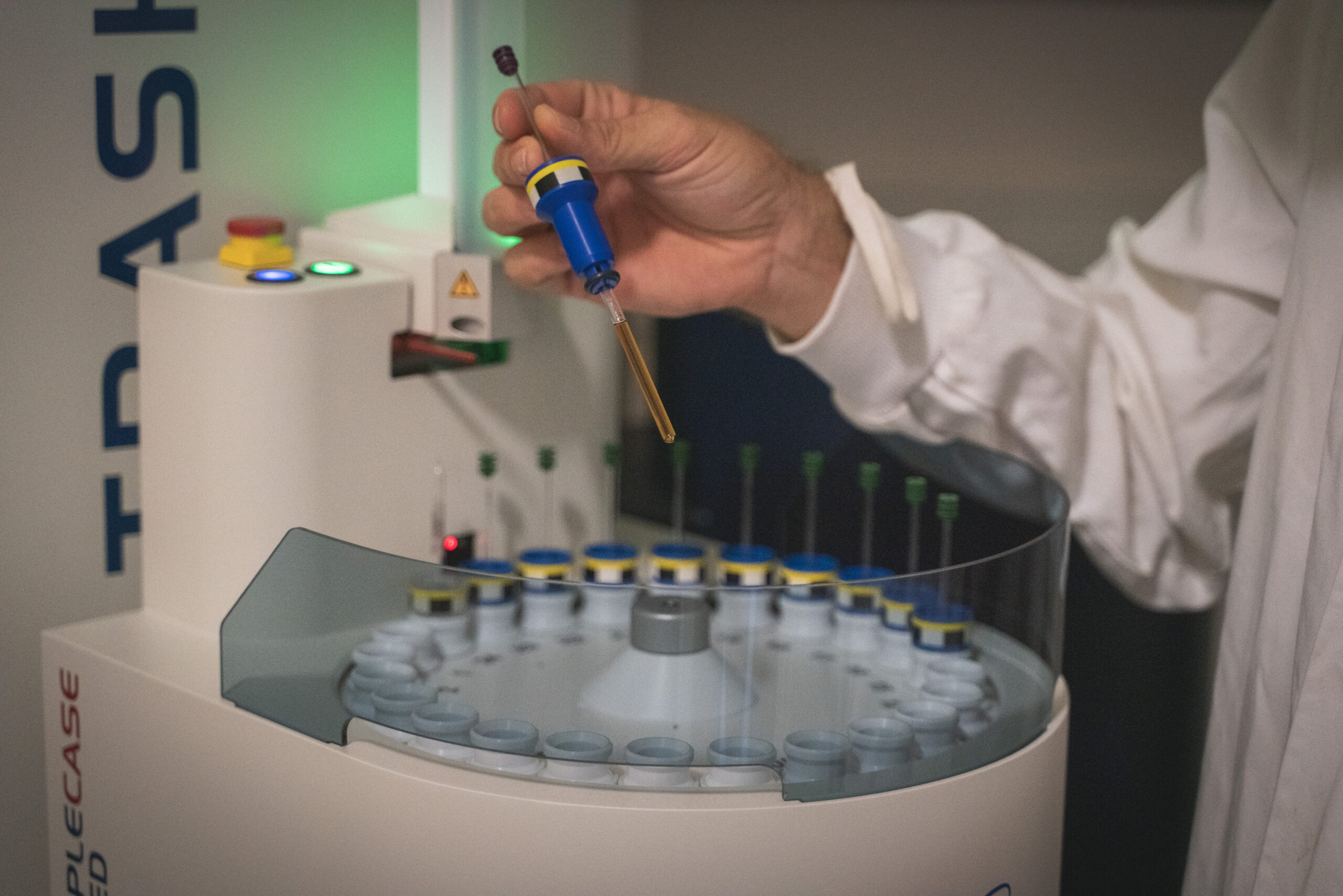
The instrument is equipped with an automated sample changer, allowing sequential analysis of numerous samples, and with state-of-the-art data acquisition and processing software.