In vitro Unit
The CYROI In vitro Unit is a multidisciplinary unit specialised in cell biology and microbiology. The team develops in vitro tests for the bioactive properties of extracts and molecules and prepares tumour cells for in vivo experiments. A wide range of analytical techniques allows the assessment of biological activities, antimicrobial effects and mechanisms of action of natural compounds.
History
The unit was established in 2023 to provide cross-functional support and cooperation with other CYROI research teams, in order to characterise the biological properties of extracts and molecules derived from local biodiversity.
The unit offers expertise in cell biology, biochemistry, microbiology and molecular biology.
Missions and objectives
The In vitro Unit carries out various activities focused on the evaluation of the biological properties of compounds.
The establishment of a cell line library of murine and human cell lines provides relevant models for the study of biological mechanisms.
The cytotoxicity tests developed in the unit assess the tolerance and safety of the studied compounds, while investigations are conducted on their anti-inflammatory, antioxidant and wound-healing potential, particularly on ex vivo models.
The In vitro Unit also works to analyse the signalling pathways involved in these biological activities and to explore the role of the bacterial microbiota, at the interface between microbiology and molecular biology.
Antimicrobial testing enables the characterisation of the properties of the extracts studied.
These activities are supported by a BSL-2 microbiology laboratory, providing a secure environment for the handling of Risk Group 2 pathogens.
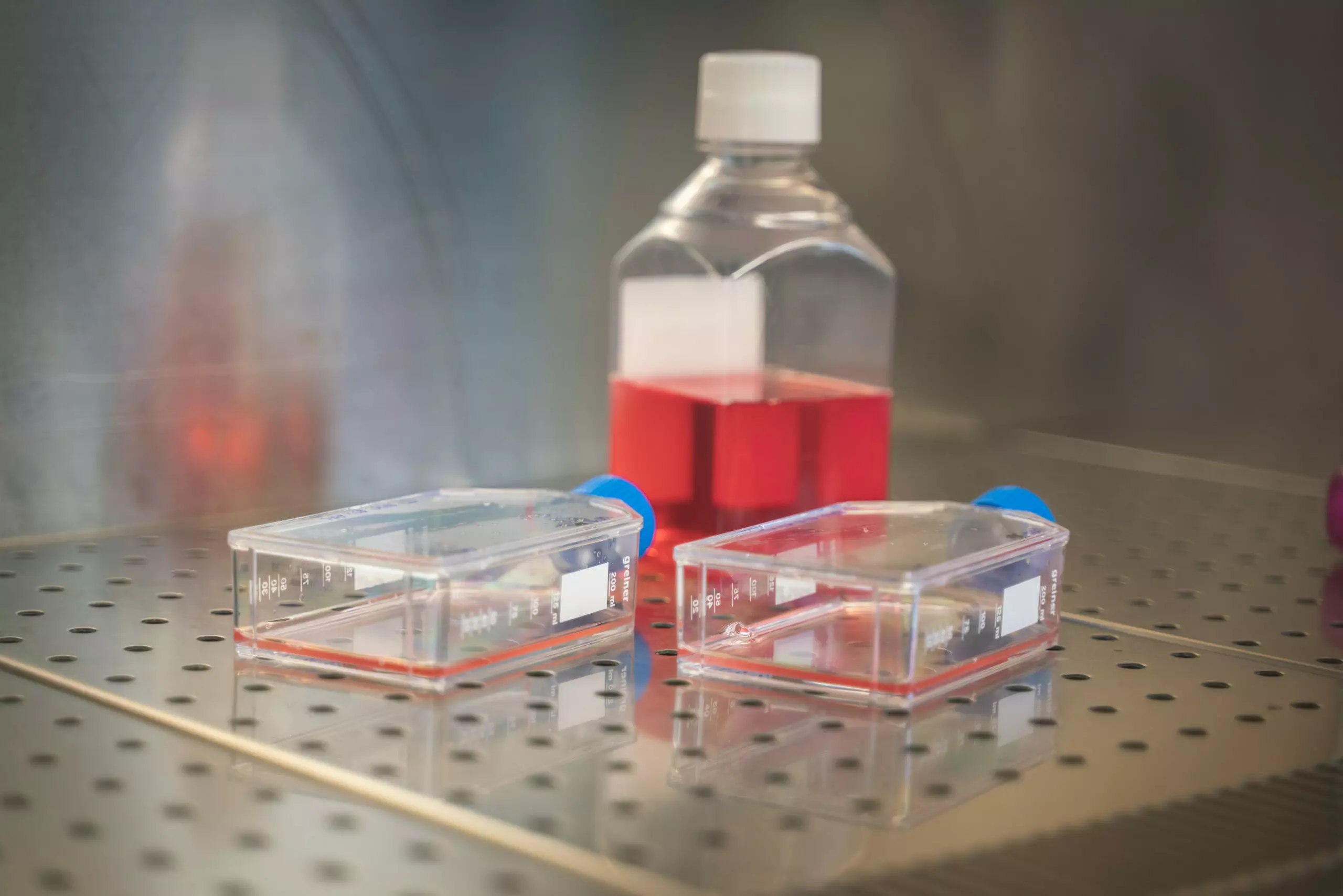
The In vitro Unit has a cell biology technology platform comprising:
- biosafety cabinets (BSCs)
- cell culture incubators
- a liquid nitrogen tank for the cryopreservation of cell lines
- microcentrifuges enabling the rigorous implementation and monitoring of experiments
Areas of expertise
Cell biology
- Murine and human cell cultures
- Development of the cell line library
- Cytotoxicity tests
- Investigation of anti-inflammatory and antioxidant potential
- Analysis of wound-healing properties of compounds on in vitro and ex vivo models
- Study of signalling pathways
- Investigation of the bacterial microbiota in connection with microbiology and molecular biology
Microbiology
- Microbiological sterility quality control
- Study of the inhibitory effects of various compounds on bacterial growth
- Biofilm inhibition or destruction tests using crystal violet staining
- Isolation and amplification of microbial strains from various matrices
- Antimicrobial testing on biofilms
- Access to a BSL-2 microbiology laboratory for the handling of Risk Group 2 pathogens
Challenges and prospects
The multidisciplinary approach of the In vitro Unit helps develop innovative approaches for the sustainable valorisation of molecules and extracts. It supports collaborative projects at CYROI and contributes to the emergence of effective ingredients derived from local biodiversity.
OUR RESEARCH PROJECTS
Remaphasol project
Étude des plantes médicinales de Madagascar et de La Réunion par éco-extraction et modèles in vitro
Exploring the biological properties of medicinal plants of the Indian Ocean
The Remaphasol project aims to study medicinal plants from Madagascar and Réunion Island through eco-extraction approaches using innovative eutectic solvents.
The resulting extracts are then analysed to characterise their biological properties, notably using experimental in vitro models developed at CYROI.
This work contributes to a better understanding of the biological potential of medicinal plants and supports the sustainable valorisation of Indian Ocean biodiversity.
Objectives
The Remaphasol project aims to:
- develop innovative eco-extraction methods for medicinal plants
- characterise plant extracts from the biodiversity of Madagascar and Réunion Island
- identify bioactive compounds through chemical profiling
- study their biological properties, notably anti-inflammatory and antimicrobial, on in vitro models
Partners
The project is based on scientific collaboration between several institutions:
GIP CYROI - Reunion Island
Project coordination, development of analytical approaches and evaluation of the biological activities of extracts on in vitro models. in vitro.
University of Antananarivo – Madagascar
Study and characterisation of Malagasy medicinal plants and microbiological analysis of extracts.
University of Reims Champagne-Ardenne (URCA) – France
Characterisation of eutectic solvents and contribution to the identification of secondary metabolites.
This project is co-funded by the European Union under the Interreg VI Indian Ocean programme, whose managing authority is the Réunion Regional Council.